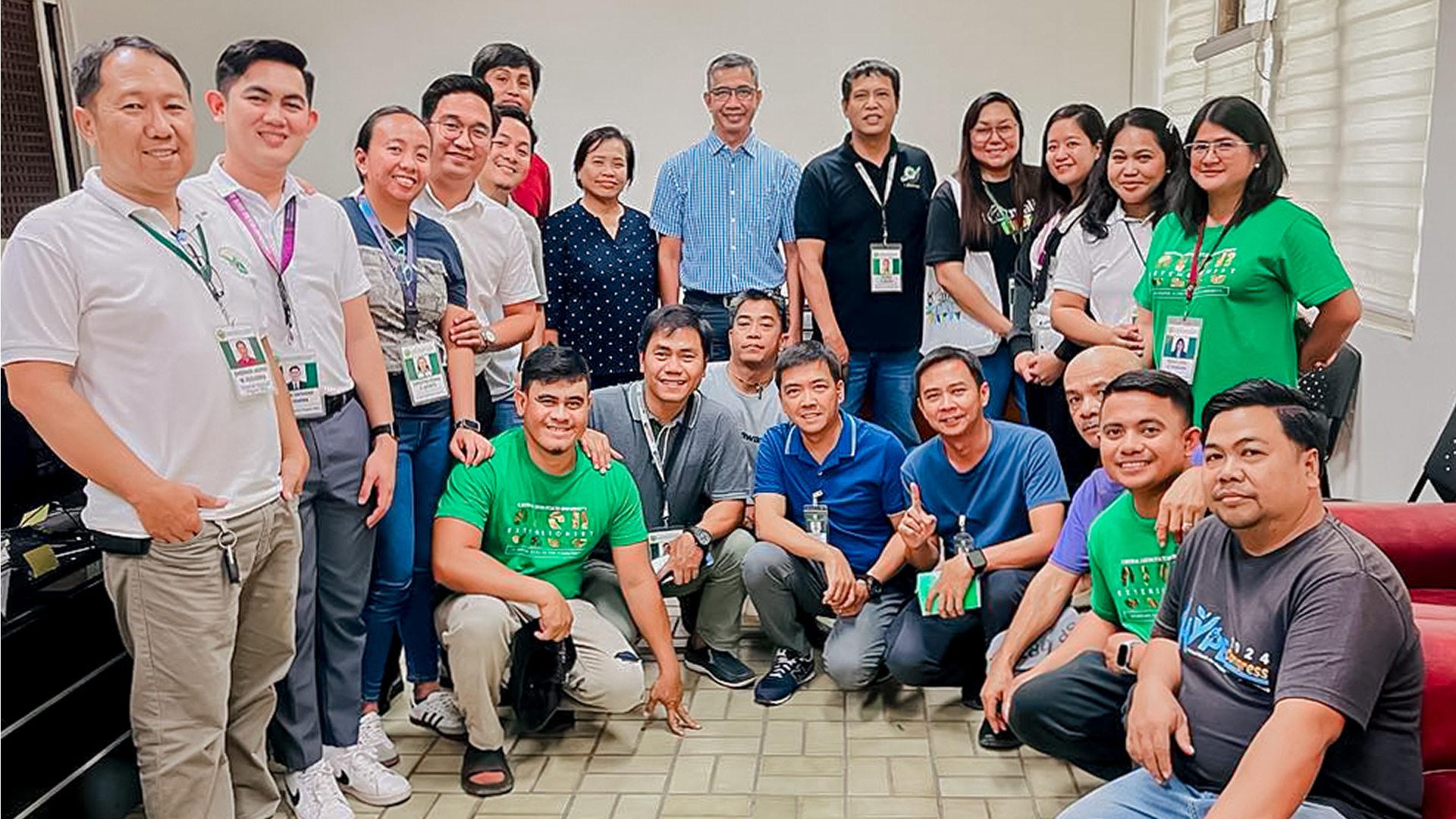

The University Extension Center (UEC) is the official unit of Central Luzon State University (CLSU) responsible for coordinating, implementing, and overseeing the University’s extension and community engagement programs. It serves as the mechanism for translating CLSU’s research outputs, academic expertise, and technologies into practical and inclusive development interventions. Anchored on the integration of instruction, production, research, and extension, the UEC advances CLSU’s public service mandate in support of food security, livelihood development, environmental sustainability, rural and community development. It ensures that university-generated knowledge and innovations are accessible and responsive to stakeholder needs. The UEC supports CLSU’s Education Economic Zone (EEZ) framework by facilitating technology dissemination, adoption, and partnerships with government agencies, local government units, civil society, and the private sector. As the implementing and coordinating body for extension initiatives, the Center provides strategic direction and quality assurance to colleges and partner units, positioning UEC as CLSU’s flagship arm for technology transfer, community engagement, and sustainable development.
The University Extension Center (UEC) of Central Luzon State University is the institutional mechanism for the delivery of extension and training services under the University’s Research, Innovation, and Extension (RIE) system. The extension function of the University traces its beginnings to the mid-1950s, when outreach activities were integrated into the instructional program of the College of Education. Faculty-led community outreach and demonstration projects in Muñoz, Nueva Ecija, supported by international volunteers, served as early platforms for experiential learning. Barangays functioned as learning laboratories for students undertaking field practice and on-the-job training, establishing the foundation for the integration of instruction, research, and extension. A major institutional milestone was the formal establishment of the Extension Office and Services in January 1964, under the Graduate Education and Research unit. This coincided with the conversion of Central Luzon Agricultural College into Central Luzon State University through Republic Act No. 4067. The Extension Office was mandated to coordinate and harmonize extension programs across colleges and units of the University. Early initiatives included rice demonstration farms, micro-farm mechanization, establishment of an artificial insemination center in partnership with the Bureau of Animal Industry, rice seed banking for Central Luzon, conduct of agricultural training programs, and collaboration with government agencies providing extension services. In 1967, research and extension were recognized as two distinct functional programs, and in 1971, each was placed under the leadership of a Director reporting directly to the University President. In 1977, research and extension functions were merged to form the Research and Development Center (R&DC). This structure later evolved into the Research, Extension, and Training (RET) system, formally recognizing training as a core academic and extension support function. Under RET, the Technology Dissemination and Utilization System (TDUS) served as the frontline extension and communication arm, operationalizing major programs such as the CLSU–Ministry of Agriculture and Food (MAF) Complementation Program beginning in 1981, and the Barangay Integrated Development Approach for Nutrition Improvement (BIDANI) Program, which ran from 1984 to 2001. During the 1990s, CLSU’s extension system expanded through national and international partnerships, including initiatives with the Sasakawa Peace Foundation. These efforts culminated in the establishment of the University Extension Program–Management Institute for Rural Development (UEP-MIRD) in 1991 under the Research, Extension, and Training (RET) Office. In 2020, pursuant to Board of Regents Resolution No. 10-2020, the Training Office was subsumed under the Extension Office, resulting in the transition from Research, Extension, and Training (RET) to Research and Extension (R&E). This restructuring formally created the University Extension Center (UEC) through the merger of the Extension and Training Offices, with training recognized as a modality of extension service delivery. In 2023, the unit was renamed University Extension Program Office (UEPO) through Board Resolution No. 7-2023. Subsequently, in 2025, following the approval of the CLSU Organizational Management Structure during the 244th Regular Meeting of the Board of Regents, the University adopted the Research, Innovation, and Extension (RIE) system. This shift institutionalized innovation as a distinct and cross-cutting function and reverted the unit to its original designation as the University Extension Center (UEC). At present, the University Extension Center serves as CLSU’s flagship extension unit under the RIE framework, ensuring that research outputs and innovations are effectively translated into knowledge, technologies, and services that directly benefit communities and contribute to inclusive, participatory, and sustainable development.
The University Extension Center is a flagship arm of the University in agricultural extension and rural development, advancing innovation, technology dissemination, and enterprise development within the framework of an Education and Economic Zone, to promote inclusive economic growth, people empowerment, and sustainable development.
The University Extension Center shall pursue integrated, multi-disciplinary and participatory programs and services that facilitate the diffusion and adoption of appropriate agricultural and social technologies within the framework of Educational Economic Zone for effective local governance, people empowerment, socio-economic upliftment and sustainable development.
The University Extension Center is organizationally placed under the Research, Innovation and Extension (RIE) Program of CLSU headed by the Vice President for Research and Innovation and Extension. This placement ensures close integration between technology generation and extension/dissemination.
The UEC Director is designated by the University President for a term of one (1) year, without prejudice to re-designation, and subject to confirmation by the Board of Regents. The Director provides strategic leadership, policy direction, and overall supervision of extension operations.
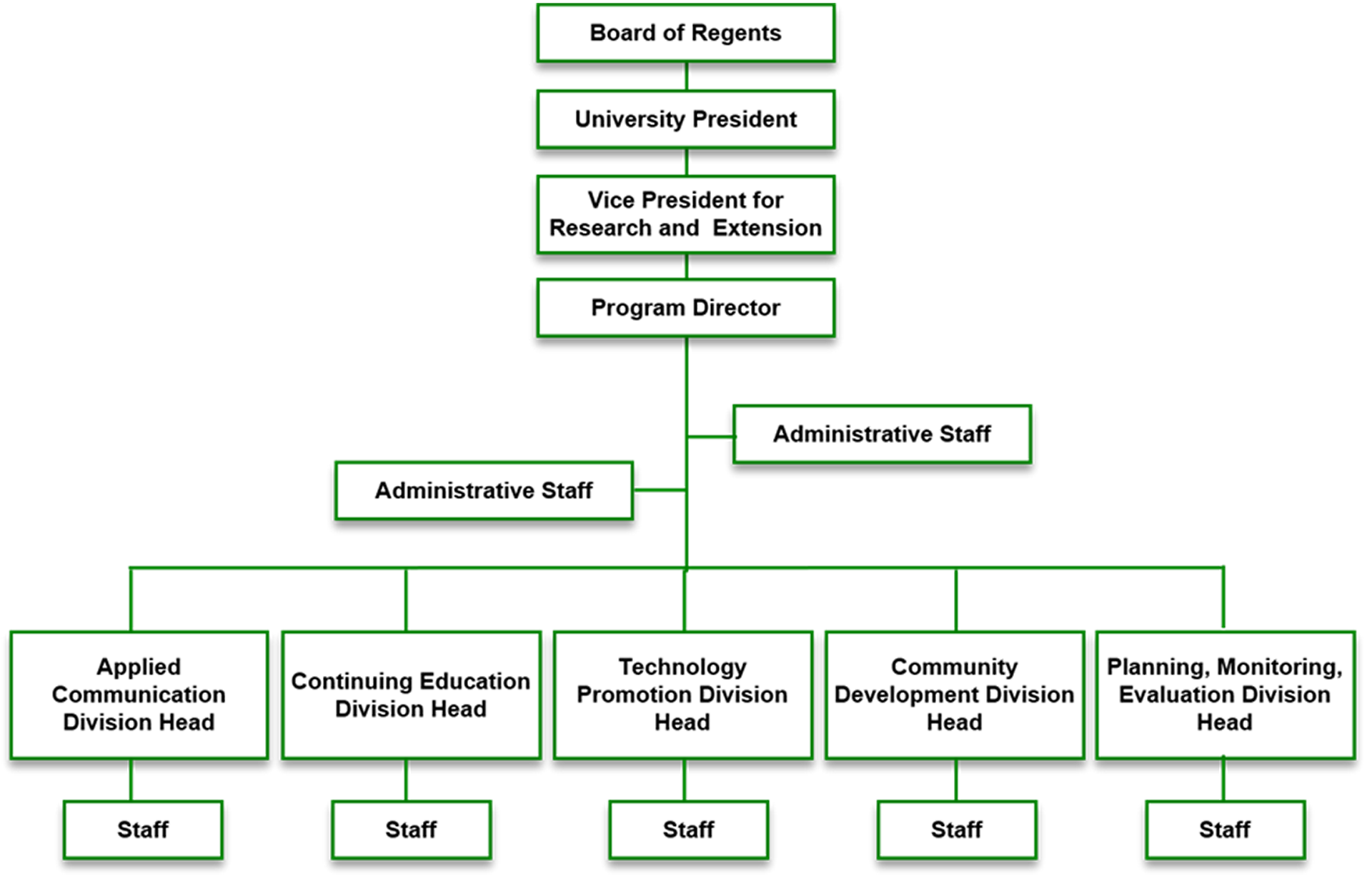
The UEC is comprised of five (5) interrelated divisions that collectively deliver extension services:
It is tasked with analyzing clients’ information needs, packaging technology, and developing information into popular print and audio-visual formats, managing radio and web broadcasts, conducting techno exhibits, and developing and maintaining one-stop information shops and techno learning centers.
As the capability-building arm of the center, it is responsible for assessing clients’ training needs, developing and implementing training based on identified priority training needs, and evaluating training to assess its effectiveness. Develop, train, and maintain a pool of experts, and strengthen partnerships with intermediary institutions to serve as training partners for communities. Training programs are delivered through face-to-face, hybrid, and online modalities, and engage trainers and experts from within and outside the university.
It is the field operation arm with duties to assess clients’ technology and project needs, establish farm demos, model farms, techno livelihood projects, and enterprise to showcase recommended technologies and management practices, facilitate and provide advisory services, and conduct field days to promote wider technology uptake.
It is responsible for implementing development models that focus on community needs, education of groups of individuals to work collectively towards socio-economic progress, coordination and convergence of agency services, and promotion of local governance. It is distinguished from extension education that focuses on individual needs and distinct clients aimed at individual development to obtain socio-economic improvement, and decision-making for change by individuals, families, and communities.
It is directly responsible for coordinating and organizing extension review and planning activities, ensuring timely report preparation and submission, monitoring accomplishments relative to quality objectives, monitoring project fund utilization, monitoring and reporting clients’ feedback, and ensuring proper management and organization of office documents. It will also strengthen coordination with college and unit extension coordinators in the planning, monitoring, and evaluation of extension programs and projects of the respective colleges and units.